Saturday, March 19, 2016

Cysts and Sleep Cycles

   It was the summer of 2013 and that meant it was time for another year of camp. My sleeping situation was far less than optimal so this year I decided I would apply to be one of the Heads of Environmental Programming. Our camp had chickens, sheep and rabbits and we'd harvest the chicken eggs and vegetables as part of the job. The reason I chose this job despite my my love for having kids as a counselor is because the schedule is far more flexible and there's less legwork. I got a little stool that I would sit on while gardening and was less tempted to try to chase after kids. It still wasn't easy though, because sometimes I would sleep in all the way until 2 pm. To harness this we essentially said I was in charge of the gardens and animals in the afternoon and my co worker was in charge for the morning. With this system and my less stressful job I was able to get through the summer without too much difficulty. The only snag I ran into was getting stung by a wasp and then over the next hour realizing I was allergic with anaphylaxis. My tongue slowly started swelling in size and my throat started closing (according to the doctor, not just me.) The nurse used an EpiPen on me for the first and only time. Interestingly enough, the allergen tests I did afterwards all came out negative.

  Although camp went well, the following months did not. Not very far into the school year my sleep stopped becoming anything even close to resembling restful. No matter how long or how little I slept, I would wake up exhausted. I could either nap to feel better but make the problem worse or go completely insane from sleep deprivation. I tried both and neither worked. My doctor tried many things as well, alternating with every medication we could think of. Nothing even made a dent in my problems. It took hours to fall asleep, and when I did fall asleep I woke up throughout the night. If there's one situation where you're most likely to lose your mind it would be lying awake at night for hours for your sixth month in a row. Eventually my sleep specialist ran out of ideas and suggested I see a new doctor. Since I was seemingly out of other options, I did so and never saw that original specialist again.

   My new sleep specialist is considered a world class expert in the field. He took one look at me and decided we needed to do a total overhaul. I would put school on hold for many months while we worked on making my sleep restorative (this was one of several factors in how I fell so far behind my age group in school.) He said the way to do this is through sleep restriction. I was still waking up at 2 pm, so he told me to set my alarm for 8 am. Obviously this was very brutal for me and I spent many months exhausted as we worked on shifting my sleep schedule. I felt too crappy to spend my time hanging out with people. Even reading and playing games took too much energy. I pretty much alternated between watching movies and banging my head on my desk repeatedly. This was also a period of time where I drifted away from many friends. I learned that the phrase "use 'em or lose 'em" applied to friends as well. Eventually my sleep schedule did indeed shift. Instead of waking up at 2 pm without an alarm I woke up at 11 am. The problem was I couldn't function at 8 am but if I got up at 11 I wouldn't be able to fall asleep on time that night because the pain made it so I could only fall asleep when completely exhausted. My neurologist wanted to see if there's a fixable problem that is the source of my pain so I got another spinal MRI. The MRI showed some Tarlov Cysts which are associated with EDS. They were really small at the time and so unlikely to be symptomatic but they do often grow, which gave me yet another thing to worry about.

Image result for tarlov cyst size

    Although the source of the pain wasn't a cyst, we were still determined to try to treat that pain. Unfortunately, all the pain pills we tried were either completely innefective or were slightly effective but had unbearable side effects. My neurologist wondered if medical marijuana might be a potential solution (relatively little side effects, good pain reduction) and so he referred me to another doctor who is a cannabinoid specialist. He would asses me and determine if I'm a good fit for a prescription of medical marijuana, something I purposefully have never partaken in before. I thought it would help my case if I didn't come off as someone who was already as stoner, which I wasn't anyway. It was something I wanted to try to help my pain for awhile and my patience had finally been rewarded.

The Truth

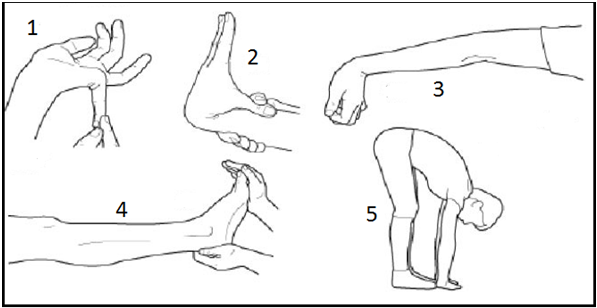
    Even though no one had as of yet diagnosed me with EDS I knew I had it. The puzzle pieces fitted together too perfectly. I knew it was only a matter of time until the diagnosis came. The first thing my new neurologist did after we told him our thoughts on me having EDS was refer me to a geneticist. There they preformed what is called the Beighton Hypermobility test. They had me stretch in many different ways to text my flexibility. 
    The results showed I had enough 'points' to be considered slightly hypermobile, but that is a bit misleading. One part of the test involved trying to touch your toes. This is something I am flexible enough to do but the pain from doing so is what limits me and so they took that into account. Based on my history, hypermobility, and symptoms, the geneticist clinically diagnosed me with EDS. This means based on what she saw it is her professional opinion that I have this disease.  To be more confident with this diagnosis I was sent get blood tests. Even if she thought I had EDS, we wanted to figure out what kind of type it was. There are many types of EDS but the vast majority of sufferers are afflicted with three main types. These are the vascular, classical, and hypermobility types. The hypermobility type was the most painful of these but the least dangerous. It affects the joints the most and is the most common type. People with this version of EDS are typically very flexible.

    The classical type mainly concerns one's skin, they have stretchy fragile skin that tears easily. The vascular type is the deadliest, for half of those who are afflicted by it are dead by their 40s. This is because it weakens your cardiovascular system including your heart and arteries. The tests I had done showed I had a gene that can be associated with the hypermobility type of EDS. While this was reassuring, (having the vascular type would mean I'd live a very short life) we still didn't have a definitive diagnosis. To remedy this, the geneticist referred me to a dermatologist. It was time for me to get a skin biopsy.

   The skin biopsy entailed me lying on my stomach while they cut a small piece of skin off my lower back. They used local anesthesia so it didn't hurt much. A few weeks later I went back to hear the results. The doctor showed me microscopic images of my skin and these images demonstrated major deformities of much of my skin fibres, which are important for maintaining the strength of your skin. As a consequence of this my skin gets cut really easily, making tasks like shaving difficult. My skin fibres were deemed to be in the shape of cauliflower, which is a classic sign of having the hypermobility type of EDS. I had so many abnormally shaped fibres that the dermatologist considered it to be a definitive diagnosis, which is a very uncommon occurrence for the hypermobility type. Upon hearing this news I immediately broke into a huge grin. I finally caught what I've been chasing all these years: the truth. The truth is that I had the Hypermobility Type of EDS, an extremely painful and incurable disease. So while I may live a long life, it will also be a very painful one. This wasn't easy to accept but still, I finally knew.


Wednesday, November 18, 2015

The Next Chapter: Closure and New Beginnings

    Although it was hard to see any progress on medical solutions being made, things hadn't come to a complete standstill. I was referred to another neurologist who was head of the pain clinic at Mount Sinai. He ran another electrocardiography test on my legs and I purposefully triggered an increase in pain beforehand by using my legs to stand up and do the slump test. I was so desperate I figured maybe increasing my pain level would make a difference on the test. It didn't. The test was negative like the one I had a couple years before. Then the doctor came in to share the results. He apologized that since I didn't seem to have an active neurological problem, he wouldn't be able to help. As I sat there despairing and gathering my things to leave I habitually cracked joints throughout my body. As anyone who spends time with me knows this is a common occurrence that I can't seem to help. The doctor noticed this and started asking me questions about my joints and flexibility. I demonstrated that I was hyper-mobile, meaning very flexible, but we were out of time and he needed to see his next patients. He told me to look up Ehlers-Danlos Syndrome when I got home and see if it fits with my story. I of course couldn't wait that long, the tantalizing glimmer of hope too great, so I looked it up in the car.

    As I googled what this strange sounding Ehlers-Danlos Syndrome (EDS) was several things caught my eye. First off was, "In some cases, the severity of the mutation can be life-threatening." I found that rather alarming, but who knows if there's a chance I even have this thing so there was no use worrying about it now. "There is no cure for EDS, and treatment is supportive, including close monitoring of the digestive, excretory and particularly the cardiovascular systems." If I had gulped at any point during that day, it would've been when I read that. I noted that this thing can be bad news but still hadn't reached any symptoms to compare with myself. "People with EDS are often misdiagnosed with hypochondriasis, depression, chronic fatigue syndrome, and other conditions because EDS is considered an invisible disability and there is generally poor knowledge about EDS among practitioners. Many sufferers of EDS have psychological difficulties as a result of frustration with the medical system and the socially inconvenient combination of appearing normal while being in severe pain." Now I was starting to see some connections. Throughout my years of illness I had been accused of having all 3 of those mental or exclusionary disorders. Suspicions of mine from that time have been confirmed many years later in that it was revealed to me that family and doctors had considered giving me placebos after the medical search turned up fruitless. The wikipedia post read: "Unstable hyper-flexible joints (it is possible to be very flexible or have "double joints" however, this is not the same as EDS) that are prone to sprain, dislocation, subluxation, hyperextension, myalgia (muscle pain) and arthralgia, (joint pain), which may be severe. Tearing of tendons or muscles and hernias are common."There we go. After reading that section I knew I had finally found my match. After over 4 years of searching, after years of being told the problem was in my head rather than my legs, I found my diagnosis in May of 2013. The description of symptoms didn't just accurately describe my current problems, they explained my entire medical history as well. I had bilateral hernias when I was nine which is not not altogether uncommon. The catch is that a year later I had a recurring hernia on my right side. To have multiple hernias of the same spot at that age is very very rare. They had to stitch up the muscle the adult way which leaves lots of scar tissue. Since I still hadn't gone through my growth spurt yet, the growing muscle laced with scar tissue caused a lot of pain throughout my childhood.

    I wasn't sure how I was supposed to react. On the one hand, I received the validation I so desperately craved after years of searching. I wasn't crazy after all. I learned that there are other people out there going through what I was. In addition, there were plenty of online tips on how to manage symptoms. Yet the other side of the coin could not be ignored. The disease was plainly stated as being incurable. It was autosomal-dominant, meaning if I had children they would have a 50% of inheriting it. I knew then that I would not, could not have biological children; at least not until a cure is found. Yes, although it is not curable now, progress is being made. They're still tracking down many of the culprit genes but gene therapy is on the horizon. Using an agent such as a safe virus or nanobots, someone's genes will be able to be rewritten much in the same way a virus spreads throughout the body. The correct overwriting genes are inserted into a medium, and they "infect" and change all the defective genes. I'd wager this cure is a few decades off, but there's no way I'd chance putting my potential kids through what I go through. I love them too much. As it turns out, by the time I reached home I was far happier than when I left. I learned I was suffering through something very real, that there are others going through the same I can start reaching out to. Most importantly, those I respect the most would stop questioning my sanity. Regardless of who was right in the age long argument of if I was ever depressed or simply miserable, I was neither by the time I walked through my house's front door.

Saturday, August 29, 2015

Fists of Fury

    My bout of Seratonin Syndrome left me more than a little rattled. I had always known how dangerous my pain was but now the very things that were supposed to help me deal with that pain have shown themselves to be just as, if not more, dangerous. By this point I had dealt with so many disappointments from the dozens upon dozens of different medications I had tried. There was always the hope that they'd bring relief and virtually all of them had either been ineffective or came with intolerable side effects (like death). Dealing with that constant disappointment was hard enough but having my own medications make me so sick was disheartening to say the least.

     It was the winter break of 2013 and my family planned a ski trip in Alberta. I didn't really want to go. Why turn down an awesome family skiing trip you may ask? Well mostly because I can no longer ski. For a person who can't ski, one of the best ski hills in the world is the last place they want to go. Maybe my parents were still worried about leaving me alone at that point and so I was somehow convinced to go. Skiing was my favourite sport and I was quite good at it if I do say so myself. I would love going on these ski trips and would always be the youngest in the 'adult' group going down the huge double black diamonds of Alberta. I would go skiing every Sunday in the winter with a skiing school called Snow Hawks. To go on a ski trip in Alberta and not go skiing was unfathomable for me. Even travelling there and back was torturous. Having to wake up early, wait in huge lines and walk around the airport is not my body's idea of a vacation. I'm not sure if it was this trip or a different one but at some point my family just pushed me around the airport in a wheelchair. Most of the actual trip consisted of me staying in our hotel room on the computer but there was one shining highlight. We went dog sledding! I love animals, especially dogs, and so it was a great experience and something I could do despite my legs. Was it worth the trip? Probably not, but I haven't a clue if I would've felt better or worse if I just stayed home alone.
     Soon after I had what would even by my warped standards be considered an especially bad day. It was one of those days where I couldn't sleep from pain but forced myself to go to school. My efforts turned out to be pointless because I couldn't absorb any information which in itself is extremely demotivating. Back then these days weren't exactly uncommon, but for whatever reason it was this day that culminated in me surpassing my tipping point. I got home very pissed off at my situation and found I couldn't bringing myself to turn on my computer and distract myself from my problems like I normally would. I simply sat there brooding for awhile, which eventually turned into weeping. It'd been years and my pain hadn't gotten any better. I couldn't manage a decent sleep even once a week. The medications I tried to fix it almost killed me and meanwhile my doctor's and family are telling me my pain is caused by a mental disorder which seemed to erase any hope of what I knew was my actual physical problem being fixed. I didn't know what was physically wrong, only that something was. I could only insist my mood was a result of my pain rather than the other way around. I couldn't possibly count how many hours I spent googling my symptoms trying to find something, anything, that would support my case. Even with all these things on my mind my sadness didn't last long... because it quickly turned to anger for all the very same reasons I was sad. What was different this time is that I wasn't angry at myself, I was angry at everyone else. I did what my doctor's instructed and it got me nowhere. I put up with them convincing my family I was crazy in the hope they'd be my salvation. They failed, and almost accidentally killed me in their failure. I was furious, and began pacing around my room kicking things over and pounding on the floor. I burst open my door and went downstairs. In retrospect I think a subconscious part of me wanted to go where someone might find and help me. Even if this was so, the rest of me had entered a blind rage. Now realize that I don't use these words 'fury' and 'rage' lightly. If you consider these things a synonym of 'mad' and 'angry' you are mistaken in the same way I was before this day occured. I had never even come close to being in such a raging fury my entire life and if that day never happened I likely would never know what those simple words truly meant. I imagine most people never will, for I was literally frothing at the mouth and thrashing wildly. I can only imagine this is the kind of state parents who see someone trying to kidnap their kid would enter. With the noise I was making those who were home rushed over and started trying to calm me down. My dog was attracted by the commotion and started rushing up to me until a parent shooed her away so she wouldn't get too close to my fists pounding on the floor. I was dimly aware of this occurring and as my mind processed it my emotions once more started giving way to sadness. The fact that my parent felt the need to shoo away the dog who I loved so much was heartbreaking and deflated me.

     When I next saw my psychiatrist and told him about what happened he rendered me speechless by saying it was a good thing. When he explained his reasoning though, it made sense. He said up until that moment I had been taking my shitty situation out on myself by being miserable. When my sadness turned to anger I was redirecting my aggression on those who might actually deserve it. He said my doctors, including, him, were supposed to help me and so it is perfectly normal to be frustrated and angry with them. He also said the scale of the event can be explained because my frustration burst out all at once after I had internalized it for so many years. I think he was right because nothing even comparable has happened since that day in 2012.

Saturday, August 15, 2015

Nightmares Both Real and Imagined

    I started school at the small private school again in September and continued making up for the lost time spent in hospitals. I returned to see my sleep specialist with the complaint that although my sleep quality has improved somewhat I am still waking up so late (12-2pm) that I missed half of summer camp. Not to mention it's hard to make any plans when you start school at 2 pm and end at 7. He put me on a new medication called Tryptophan which is a naturally produced chemical like Melatonin. I didn't find it particularly effective and so we kept raising the dosage. Eventually something did happen but it was far different than what we were hoping for. I started having very strange nightmares, far more visceral than anything i'd experienced before. The one I remember is me being in a basement at the bottom of a staircase. I felt the urgent need to get up the stairs; perhaps something was chasing me. I tried to begin ascending the staircase but when I tried to move it felt like the force of gravity had increased one-hundred fold, pushing me towards the ground. My vision took on a dark green hue and was shaking as if there was an earthquake. As all this happened there was a high pitched ringing in my ears and when I tried to crawl up the stairs I woke up drenched in sweat. It was then I remembered I had an exam later that day.

   The nightmare was pretty disturbing and left me feeling tired but I had enough physical problems to deal with to let emotional ones stop me from going to school and taking my exam. As I prepared to begin writing it I started feeling quite ill. My stomach was hurting and I had a feeling of malaise and feverishness. I was still able to think clearly and knew the material quite well ( I had worked my ass off studying the past week) and so began writing as if nothing was wrong. Over time my stomach continued to worsen, cramping awfully. I began to sweat but forced myself to keep writing. I suddenly urgently needed to go to the bathroom and so stopped writing to do so. It was horrible, and had by this point developed into the worst stomach ache of my entire life, diarrhea galore. I almost couldn't breath because of the cramping but went back to continue writing. Then I had to run to the bathroom again and this cycle of writing a page then running back and forth repeated many times. I was obviously very embarrassed especially when the staff had to come and ask if I was O.K. Eventually though, I finished the exam and rushed home right away. I think I asked a parent to pick me up because I was at that point extremely concerned.

     With my stomach temporarily cleared I was able to go to out for dinner with the family but this is when I began feeling irritable, which caused me confusion. Sure I had been irritable before like anyone else but it was always for a clear specific reason. I thought of anything else that was out of the ordinary which could be related and remembered the new medications along with my nightmare. I googled my symptoms along with my new and old medications and lo and behold, many results for something called Serotonin Syndrome appeared. This syndrome had occurred as a consequence of my Mirtazapine medication interacting with the tryptophan.  I had never heard of it before but quickly learned:"Serotonin Syndrome is a potential Symptom of any number of life-threatening drug interactions which may follow therapeutic drug use, combination, or overdose of particular drugs."
Cognitive effects: headache, agitation, hypomania, mental confusion, hallucinations, coma
 Autonomic Effects: shivering, sweating, hyperthermia, vasoconstriction, tachycardia, nausea, diarrhea. Somatic Effects: Myoclonus (muscle twitching) hyperreflexia (manifested by clonus), tremor." The progression of this typically starts with a feeling of illness followed by a severe stomach ache and then mental changes like agitation. At this point people mentally deteriorate very quickly, causing victims to essentially go mad until they potentially die. Thankfully I only got to the point where I started feeling irritability. To top it all off I found many people who went through their own episode of Serotonin Syndrome mention their own strange nightmares. The life threatening part was more than a little concerning so I got in contact with my sleep doctor who confirmed my suspicions as correct and of course advised to discontinue both medications immediately. I went back on Mirtazapine later but didn't touch Tryptophan ever again. Googling your own symptoms on the internet will end badly the vast majority of the time but this time thinking to do it may very well have saved my own life. At least it turned out with me getting 90-something on an exam I did while suffering a life threatening drug reaction. It just goes to show how awful I would have to feel to give up on something. If I ran away every time I felt like shit I wouldn't get anything done. Unfortunately it appears once in a while such perseverance can be dangerous...

Thursday, June 18, 2015

Desperation is the Death of Reason

     My first visit to the naturopath started off pretty well. His office was littered with pseudo-science hogwash, but he seemed intelligent enough. He used some sort of machine that ran along my spine to test its tightness, and sure enough it showed tightness that corroborated with where I felt it. He then went to work on my back and legs, loosening muscles here, pressing on nerves there. I was suffering from a bout of sharp leg pain at the time, and after he did whatever he did that sharpness was gone for about 15 minutes but the dull ache remained. Nevertheless, it seemed pretty promising so I booked a follow up appointment. As you may have noticed from before, I said that my interactions with him “started off” well. The implication that it ended badly is correct. This is because my second appointment was nothing like the first. For starters, it wasn’t private like the first one was. When I arrived there were nearly 20 people all lying on massage tables throughout a room. I was led to mine, and my worries at that point proved warranted. He treated 20 people at the same time in the only way that is possible for one person, by going from patient to patient only spending 15 seconds on one before moving on the next. In total we each got a minute or two of time spent on us for the half hour appointment we paid for, because naturopaths aren’t covered by the Ontario Health Insurance Plan. It goes without saying I didn’t get any of the relief I did in my first visit, and so I stopped seeing him then and there. I still wonder how much bank he was rolling in by treating 20 patients at a time.


       The osteopath was a little more competent. He essentially acted as a chiropractor, physiotherapist, masseuse, and naturopath all in one. He too focused a lot on my spine and gave me certain exercises to do at home. At first it seemed like there was improvement, but over time I came to the realization it was just a coincidental fluctuation in pain. The only real benefit I was getting was from the massage aspects and I already had a good masseuse for that. I decided there was no point in continuing to see him, and him raising his prices didn’t help matters. Like the physiatrist, he espoused the benefits of an epidurolysis procedure and told me the name of which doctor he recommends that preform them. When I looked up the doctor online I had saw a lot of people were extremely upset about doing the expensive procedure, saying how their pain got worse rather than better. This gave me the impression the surgery made problems worse just as often as it helped. Even this wasn’t enough to disinterest me from trying it at the time.  This is because I still held the belief that if I didn’t find more pain relief I than I was getting I would eventually once again decide the only escape is suicide. Essentially for me, any risk was better than the status quo. I now know how wrong I was, because I now know what the source of my health issues are. I discovered from the doctor who eventually diagnosed me that the procedure would have been not just expensive and ineffective, but devastating for my body vulnerable. Furthermore, as details about the doctor who was recommended to me emerged, I found out he does the procedure for anyone who has the cash, regardless of if he thinks it will help them or hurt them. This brought my dad and myself to the conclusion that there was a bit of a referral racket going on between the physiatrist, the osteopath, and the surgeon in the U.S. They probably received kickbacks from each other for bouncing patients like me between them. We can’t prove this, but it is the most plausible explanation of their reckless disregard for patient safety. My personal lesson learned is that desperation is often the death of reason.

Saturday, June 13, 2015

Summer Sleeps

      Now that the sleep doctor had seen how much my pain was interfering with my sleep he started prescribing me medications to help my brain relax. There were improvements right away but changing a sleep schedule as abnormal as mine takes time. Slowly, minute-by-minute, I normalized my schedule. Eventually I was able to start classes at 11 am rather than 2 pm, which while still isn’t even close to normal is clearly far better. As my sleep improved, so did my marks. Finally I felt like my mental functioning was returning, being on morphine and other sedating medications not to mention being stuck in a hospital for so long had put me out of practice.
     It was summer, which meant it was time for camp once again. This was my first year as a staff member, and I was assigned to be a counselor for the kids in grade 6. This is nerve-wracking in itself but I was worried about how it would play out in terms of my health issues.This was a rather tricky business, since I was still often waking up around lunchtime. It was a tragedy to miss every breakfast and all the accompanying pancakes. Thankfully I was assigned to a group of 3 other counselors so hopefully my missing of the mornings wasn’t a bigger problem than I noticed. Other health accommodations I needed were provided for me, a big one was being exempt from being required to sleep in the same cabin as the kids I was in charge of. There were two other counselors in that cabin, so that also wasn’t too much of an issue I hope. When an empty cabin was available I would sleep there, but when it wasn’t I was allowed to sleep with the adult specialists in a small house on the campgrounds. There were very considerate about not waking me up at night and  I was able to function pretty well given the circumstances. Sure, I couldn’t go on the canoe trips or play the sports, but I felt like I had a good presence. Even with all my accommodations the increased amount of walking required from at being camp took its toll, even more so than usual due to my added responsibilities as a counselor. I was able to stay for the last 2 weeks, but only by taking a break 3 weeks through the summer (the halfway point) and going home for a week to rest up. I came back refreshed, and all things considered had a pretty fun summer.
    I dreaded being judged for things out of my control and so before camp gave a little explanation of my situation to the current staff. I explained that I take lots of pills at night and so will be really out of it for about an hour before going to bed. I mentioned that there are a lot of physical things I can't do and so if I am asked for help I might need to refuse but not out of a lack of wanting. Finally I said that just being at camp is far more walking from place to place than I'm used to and so I may get occasionally grouchy or exhausted from pain spikes. I was received warmly and didn't have many issues that I noticed with my co workers in that respect. Another challenge is that the kids I had were 11-12 years old who like to run around a lot. When they wouldn't go to where they were supposed to I would sometimes feel the need to chase after them which would aggravate pain levels. Despite the difficulties, I had a great time and found being a counselor manageable with some adjustments along the way to the next year.
  
   I also started looking for new solutions for alleviating my pain; after all, my psychiatrist stubbornly insisted there was still hope. As a start I began getting weekly massages. This may sound like a pleasant, relaxing experience, but you’d be surprised at how untrue that is for me. As I now know, due to my defective connective tissue my muscles locked in place to compensate. Untightening those muscles to that degree is quite painful, particularly the hip flexors. Despite that it is still very worthwhile to get even a short relief from my locked tendons, even though they inevitably get just as tight again after a few days of use.


     The next specialist I saw was a physiatrist on the recommendation of my psychiatrist. When he examined me he got me to do something he called the Slump Test, though it is more commonly known as the Straight Leg Raise Test. It involved me sticking out my legs while sitting down in the straight line of a 180-degree angle. I was then told to lean forward, which caused my leg pain to get worse to a great degree, but this was followed with immediate relief once I put my legs back down. This is supposed to be a sign of neurological hyper-sensitization, because it positions your spine in such a way that it will cause pain for people with neurological issues but none for those without. This essentially just showed my nerves were firing when they weren’t supposed to, causing something he called neurological tension. He had five potential solutions for me to try. First I tried acupuncture, which had no effect except making me really tired. I literally fell asleep on the table while they were sticking needles in me. The next idea was a pain medication called Cesamet. This is a synthesized THC pill (THC being the main active ingredient in marijuana.) The pills didn’t reduce my pain, but they did make it bother me less. The physiatrist also told me of a procedure called Epidurolysis, which in simple terms involves the flushing the spine. Here’s the short official explanation: “Epidurolysis procedure is used to loosen and dissolve some of the scar tissue from around entrapped nerves in the spin, so that medications such as cortisone can reach the affected areas, and so that scar tissue is less painful.” He said that they only preform this procedure in the US, and that it is quite expensive. To my then desperate self it felt like a miracle solution, and I was eager to try anything and everything to alleviate my pain. As a doctor himself, my dad was more skeptical. We put it on the back burner for the time being. Lastly, the physiatrist referred me to an osteopath and naturopath colleague of his. I booked appointments with both immediately.